


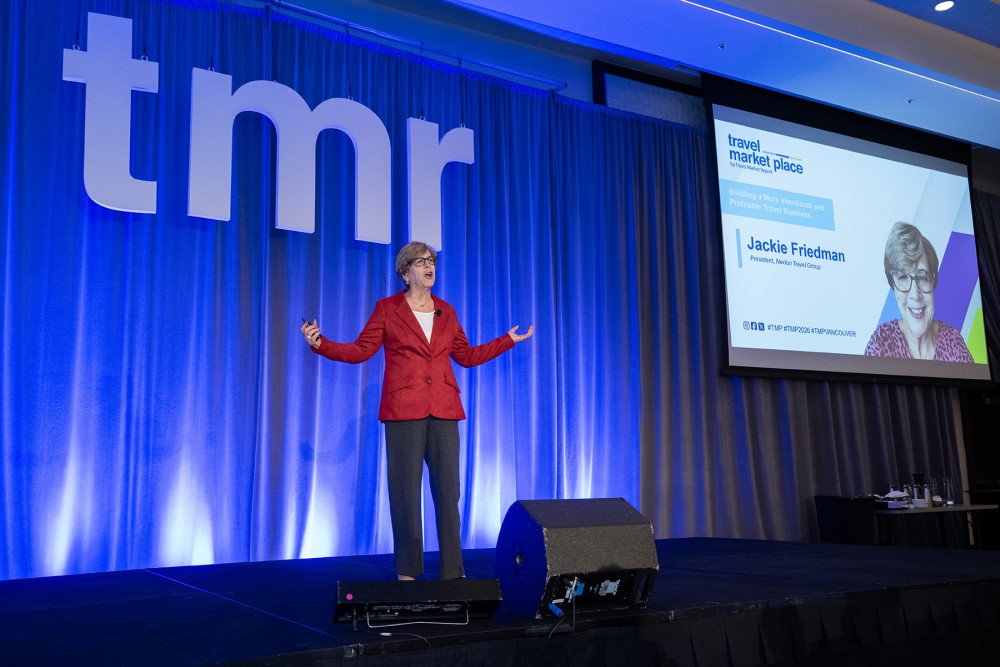
According to Jackie Friedman, president of Nexion Travel Group, travel advisors must understand how to break free from the busyness trap. She addressed a large audience at last month’s Travel Market Place held in Vancouver, Canada.
Simply being busy does not equate to being effective, and in reality, it can hinder business progress.
Breaking away from the busyness trap necessitates a shift in mindset that prioritizes thoughtful and strategic planning.
“You all wear multiple hats…,” Friedman noted. From agency management and bookkeeping to selling travel and engaging in social media marketing, advisors juggle numerous responsibilities. When compounded with constant email interruptions, there is increasingly less time available daily to make meaningful progress in the business.
“You spend more time responding than leading,” she explained. “That pressure to do everything can become truly daunting.”
When advisors predominantly react to situations, they often waste time on activities that provide little to no benefit for business expansion.
“Achievement comes from concentrating on what is most important,” Friedman emphasized.
To move away from the busy trap and redirect their focus from reactive tasks to activities that foster business development, Friedman suggested that advisors start to be more mindful in their decision-making, initiating this with planning.
Wheel of Focus
Friedman introduced the concept of the Wheel of Focus as the first step, likening it to the three Rs of early education—reading, writing, and arithmetic—which lay the foundation for learning. Similarly, she stated, the Wheel of Focus serves as the foundation for business growth.
The Wheel of Focus includes three key components: results, relationships, and recharging.
“Each of these aspects holds equal significance,” Friedman pointed out.
Wheel of Focus – Results
She referenced the 80/20 principle, suggesting that 80% of sales generally come from 20% of clients, and proposed that merely 20% of an advisor’s daily activities drive 80% of their desired business outcomes.
“Should that be where your focus lies? Absolutely,” she affirmed.
Wheel of Focus – Relationships
Next on the Wheel are relationships, whether with clients, supplier partners, or fellow business professionals.
Friedman described these relationships as an advisor’s “most valuable asset,” asserting that maintaining them is crucial for business growth.
“It’s vital to cultivate these relationships,” she stated.
Advisors should ensure that they dedicate time every day (or at least once a week) to reach out and make their key clients feel valued and significant.
Additionally, time should be allocated for contacting supplier partners. It’s important for local Business Development Managers (BDMs) from the suppliers you are working with or wish to work with to recognize who you are.
“Initiate contact with them. Express your desire to meet and discuss how you can collaborate to enhance both your businesses,” she advised.
Lastly, advisors should also find time to connect with peers. This could include engaging with other advisors or local business leaders in the community.
Wheel of Focus – Recharge
Arguably the most overlooked component of the Wheel of Focus is the aspect that encourages individuals to reflect inwardly, carve out time for self-care, and recharge.
“If you’re feeling burnt out, fatigued, and drained, how effective can you really be?” Friedman queried. “While prioritizing, don’t overlook those essential moments that allow for recharging.”
Busy Advisor vs. Focused Advisor
Friedman presented a contrast between two types of advisors, one who is busy working hard in their business, and the other who also puts in significant effort with intention and focus on their business.
For example, the busy advisor begins their day absorbed in their inbox, promptly reading and addressing emails. The focused advisor, on the other hand, starts their day with a clear intention.
“They place importance on those elements that will significantly benefit their business,” she explained. “They ensure that if nothing else gets done today, these crucial tasks will be completed.”
The busy advisor attempts to cater to everyone who approaches them, while the focused advisor directs their services towards their ideal client—even when it necessitates saying no at times.
“You might not be familiar with the word no,” Friedman remarked, noting that using it appropriately can be “empowering, as sometimes saying no is the most appropriate action.”
The busy advisor juggles multiple tasks throughout the day, switching from one to another and then returning again. Conversely, the focused advisor has learned to group related tasks, such as social media posting, responding to emails, or invoicing. Whenever feasible, the focused advisor even automates (or delegates) some of these tasks to avoid redundant manual work.
Most critically, the focused advisor understands the distinction between working on their business versus working within it, ensuring they dedicate time weekly to the former. As a result of this intentional approach, Friedman noted, the focused advisor feels they control their business instead of being controlled by it, which often leads to exhaustion.
Tips to Shift Your Mindset from Busy to Focused
1. Start Your Day with a 3-3-3 Daily Focus Framework
In constructing your daily agenda, Friedman stressed the significance of keeping the three Rs in view, starting with results.
It’s essential, she asserted, to include three revenue-generating, results-oriented tasks in your daily plan. Activities might involve sending out trip proposals or follow-ups, or making calls to finalize sales, and so on.
“Completing these three tasks will directly lead to business and revenue,” Friedman clarified.
Each day’s list should also contain three tasks concentrating on relationships. Examples could be calling a client you haven’t connected with in a while, having lunch or a Zoom discussion with a supplier BDM, or attending a local Chamber of Commerce networking event—all of which are significant relationship-building tasks.
The final three tasks should be related to recharging and can be as straightforward as taking a coffee break between tasks or going for a brief walk or playing with your pet.
“Whatever it may be, choose something that will invigorate you and help establish balance,” Friedman suggested.
2. Adopt the 10-Minute Rule for an Overdue Task
When reviewing your daily task list, particularly later in the day or reflecting the next day, identify any overdue tasks and consider, “Is this something I can accomplish in 10 minutes or less?”
If yes, tackle it immediately. If no, evaluate the significance of the task. If it proves essential, add it to your list for that day or later in the week, committing to complete it. Conversely, if it appears unimportant, contemplate if it can be delegated or simply omitted altogether.
3. Batch Similar Tasks
Instead of multitasking and oscillating between unrelated activities, grouping similar tasks can accelerate efficiency.
For instance, batching similar tasks might entail checking email only at specific times each day, or designating two periods a day solely for preparing and dispatching quotes.
“You might even consider assigning certain days of the week for particular types of tasks,” Friedman suggested, such as reserving a two-hour block on Mondays exclusively for administrative work. Or perhaps on Fridays, consolidating and scheduling all social media posts for the upcoming week.
4. Use the “Delegate or Delete” Test
This approach reintroduces the three Rs of focus. For each task on your to-do list, ask: Does this contribute to my business growth? Does this strengthen a relationship? Does this invigorate me?
If any of these is affirmative, proceed with it. If all three responses are negative, seriously contemplate delegating it to someone else (like a virtual assistant or even leveraging AI) or simply discard it. It may not hold as much importance as initially perceived.
5. Adopt the “One Touch Rule” for Email
Allowing emails to accumulate can be a source of distraction. The knowledge that numerous emails await your action can be overwhelming. Rather than letting them build up, respond to each email upon opening it. (Even while batching email reading, adhering to this principle can be beneficial.)
Responding to an email may involve deleting it or flagging it for future reference (if it contains important information that doesn’t require immediate attention). If you have team members, addressing an email might entail delegating the response to someone else. For quick replies, handle it right away. It might also pertain to integrating it into a larger task you have planned, like compiling multiple quotes on a Wednesday afternoon.
6. Automate at Least One Task a Month
Are there tasks that you repeatedly handle throughout the week or month? If so, consider how to automate them. For example, is there software that can automatically send out birthday greetings or trip anniversary emails? Can you establish a welcome email sequence for new clients that starts automatically upon booking? Can you create a review request email that sends automatically?
For each task you frequently find yourself repeating, explore options for automation. This may involve consulting with your host agency or consortia about available tools. It could also mean soliciting assistance from AI.
Ultimately, the more tasks you can automate, the more time you free up for engaging in business-building activities that will propel your growth.
7. Identify Your Top 20% Clients
Understanding your customer base significantly contributes to recognizing pathways for business expansion and which relationships require nurturing. Develop a straightforward metric or metrics that suit your needs—whether it be revenue, referrals, responsiveness, or enjoyment of working with—and identify your top 20% clients.
Once identified, establish a system to provide them with exclusive touches, which may include offering loyalty rewards, allowing them to skip ahead in the proposal queue, or simply sending a handwritten note expressing your appreciation for their business.
8. Commit to a Weekly CEO Hour
Reiterating the importance of working on your business, Friedman advised advisors to allocate time outside of their daily activities to reflect on the business and future developments. These time slots should be scheduled deliberately rather than left to chance.
Typical tasks associated with business reflection might include setting goals, analyzing revenue and its sources, reviewing your business pipeline, assessing which activities produced measurable outcomes, and strategically planning for the following week’s tasks.
9. Honor Your Boundaries
Busy advisors often find themselves overwhelmed. They struggle with establishing when and how to decline requests, allowing work to encroach upon their personal time. A crucial part of the transition from being busy to focused involves recognizing the boundaries necessary to establish and then adhering to those, said Friedman.
If you operate from home, choose a daily quitting time. Establish upfront expectations with clients, informing them that responses to emails may take up to a specified number of hours (generally within 24 hours).
Fonte: Travel Market Report
