


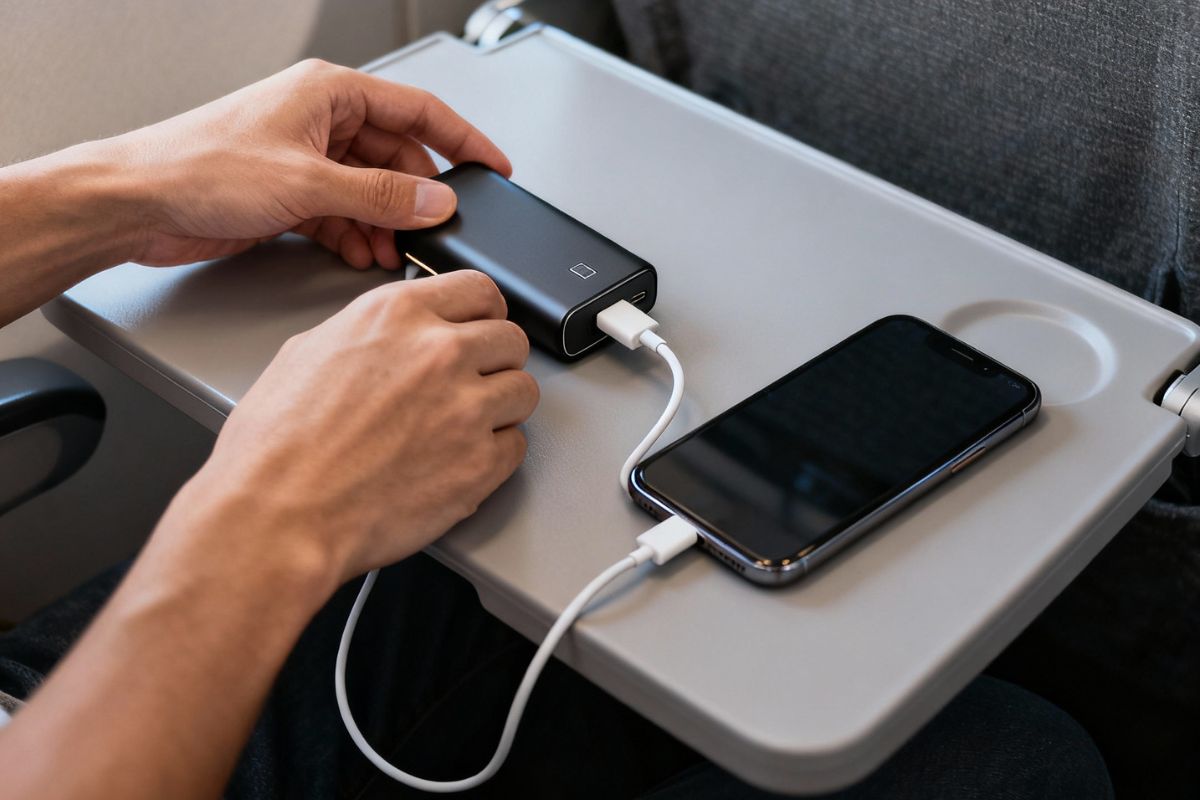
The nation of Japan is implementing more stringent regulations regarding power banks during flights, which includes a prohibition on their usage and new restrictions on how many a traveler may carry. This decision comes in response to an increase in battery-related fire emergencies and revised global aviation safety recommendations.
Japan is enhancing the regulations surrounding power banks on airplanes. Frequent travelers to or from the country should take note.
The Ministry of Land, Infrastructure, Transport and Tourism has announced that flight passengers will soon not be permitted to utilize mobile battery packs in-flight. These updated guidelines are anticipated to be enforced by April 2026.
Let’s clarify what this entails for passengers.
Prohibition of Power Bank Usage During Flights
According to the revised rules, aircraft passengers will not have the opportunity to use power banks on flights.
This encompasses powering up your smartphone, tablet, or any other gadget utilizing a portable battery pack while airborne.
This resolution follows safety deliberations at the International Civil Aviation Organisation, which has already banned battery charging on jets and is contemplating recommending a wider prohibition.
By making this move, Japan is responding to international safety apprehensions.
Regulations on Battery Allowance
Clear restrictions will also be established on the number of power banks a passenger can take onboard. Here’s the breakdown:
- Power banks exceeding 160 watt-hours are strictly prohibited.
- Up to two power banks that are 160 watt-hours will be allowed per passenger.
- An unlimited number of batteries below 100 watt-hours.
- Two batteries ranging from 100 to 160 watt-hours.
The forthcoming adjustments primarily influence power bank usage on the aircraft, rather than their transport.
These stipulations will be relevant to all flights departing or arriving in Japan, irrespective of whether the carrier is a Japanese airline or a foreign one.
Airlines have already been notified and will be tasked with ensuring compliance among passengers.
Rationale Behind Japan’s Decision
Here’s the critical point: Lithium-ion batteries have the potential to overheat, which can lead to rapid ignition. Since power banks utilize these lithium-ion batteries, damaged or overheated units can combust.
As per the data from Japan’s National Institute of Technology and Evaluation, there were 123 incidents related to batteries in 2024, compared to only 47 in 2020, showcasing a significant uptick over a short timeframe.
A majority of these cases involved batteries igniting while providing power to smartphones.
Real-life examples related to aircraft include:
- In January 2025, an aircraft operated by Air Busan experienced a fire incident at Gimhae International Airport.
- In October, smoke was emitted from a battery on an All Nippon Airways flight traveling from Naha to Tokyo.
This issue extends beyond aviation; in July 2025, a battery fire on Tokyo’s Yamanote train line resulted in five injuries.
This clearly indicates that the risk has transitioned from being speculative to very real.
Airlines Enforcing Restrictions or Bans on Power Banks
Japan is not alone in its cautious approach; numerous global airlines have enacted stricter measures concerning power bank usage during flights due to hazards associated with lithium batteries. Most permit passengers to have them in cabin luggage but forbid their use or charging while airborne.
A list of 15 airlines that have imposed restrictions includes:
- Emirates
- Singapore Airlines
- Scoot
- EVA Air
- Thai Airways
- AirAsia
- Tigerair
- Starlux Airlines
- China Airlines
- Air Busan
- Malaysia Airlines
- Firefly
- MASwings
- Vietnam Airlines
- Vietjet Air
Recommended Actions for Travelers
If you have plans to fly to or from Japan in the near future, it’s wise to prepare accordingly.
- Fully charge your electronic devices prior to boarding the flight.
- Try to bring fewer power banks if possible.
- Inspect the watt-hour limit indicated on your power bank.
- Adhere closely to the directions provided by the airline crew.
Since July, Japanese airlines have urged passengers to keep batteries accessible and avoid putting them in overhead compartments while in use.
The imminent ban will take a further step by eliminating any usage in-flight.
For those who frequently travel, digital nomads, or business professionals reliant on portable chargers, these changes may call for slight adjustments. However, from a safety standpoint, it’s understandable why regulators are taking this matter seriously.
Traveling by air remains one of the safest modes of transportation globally. Regulations like these are implemented to maintain that safety.
Fonte: Travelo Biz
