


The U.S. Embassy in India is experimenting with revamped B1/B2 visa categories for some candidates, introducing additional verifications that may influence appointment scheduling and visa processing times.
If you’re considering traveling to the United States on a B1/B2 visa, you might notice a minor yet intriguing adjustment occurring behind the scenes.
The U.S. Embassy in India is seemingly trialing a new approach to categorizing visa applicants. Although this isn’t an official regulation just yet, and not everyone can access it, one of our followers from Kolkata reported encountering a new array of categories during their application process.
What Modifications Are Happening with B1/B2 Visa Categories?
Previously, the application process for a B1/B2 visa was relatively uncomplicated. You would choose your visa type, complete the DS-160 form, and set up your appointment.
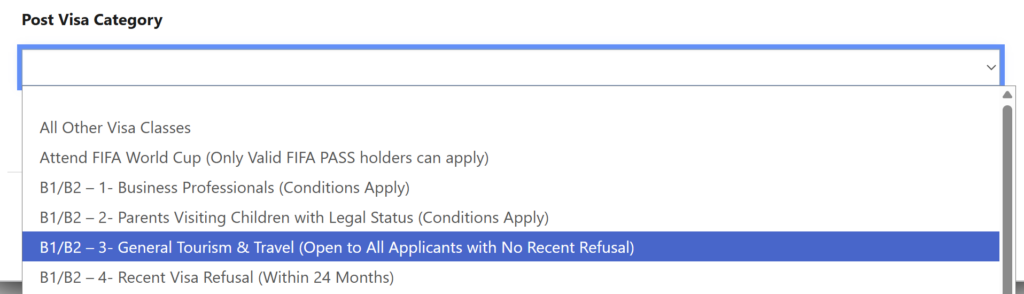
However, some applicants are now presented with four additional sub-categories related to B1/B2:
- Business Professionals (certain conditions apply)
- Parents Visiting Children with Legal Status (certain conditions apply)
- General Tourism & Travel (for applicants without prior refusals)
- Recent Visa Denial (within the last 24 months)
Currently, there’s no formal clarification on what these “conditions” entail.
It’s important to mention that, under the B1/B2 Visa, candidates typically opted for just one unified visa type for:
- Business (B1)
- Tourism/visiting family (B2)
There was no formal subdivision into sub-categories like those appearing now (business professionals, parents visiting children, etc.)
Double-Check Your Responses
This is where it becomes more intriguing. After selecting a category and inputting your DS-160 number, the system prompts you to verify that you’ve chosen the correct category. It also provides a gentle reminder: Should you supply incorrect or deceptive answers, it may impact your visa eligibility.
What Is the Reason for This Change?
Although there hasn’t been an official declaration, the likely explanation is straightforward. The U.S. visa system is currently experiencing overwhelming demand and prolonged wait times, particularly in India. This categorization may help:
- Classify applicants based on their background
- Differentiate first-time applicants from those with previous refusals
- Accelerate appointment scheduling
- Assist embassies in managing their workload more effectively
In essence, it appears to be a data-oriented strategy to address high volumes of applications.
What This Might Imply for Applicants
If this trial extends to other cities, it could alter how appointments are assigned. For instance:
- Applicants with prior refusals might be treated differently
- Parents visiting their children could receive priority or be categorized separately
- Having a clean travel record may become more critical than it previously was
While none of this is concretely confirmed, the structure indicates a more segmented system may be forthcoming.
Avoid Attempting to Manipulate the System
This aspect is crucial. The system explicitly cautions applicants to respond truthfully. There’s good reason for this.
In the past, numerous U.S. visa candidates have attempted to skew their answers in order to secure faster appointments. In many instances, this resulted in:
- Appointment cancellations
- Loss of visa application fees
- Profiles being flagged
Therefore, when encountering these new categories, choose wisely and honestly.
Is This Change Here to Stay?
At present, this appears to be a limited trial, accessible only to select applicants. It remains unclear if this will expand to additional U.S. consulates in India or worldwide.
However, if it does, it could significantly influence how B1/B2 visa applications are processed in the future.
Conclusion
This may not represent a significant overhaul just yet, but it clearly indicates an evolving landscape. The U.S. visa application process is becoming more structured, increasingly data-centric, and potentially more selective regarding application handling.
If you plan to apply soon, stay vigilant about these changes. More importantly, ensure your application is accurate from the outset.

Editorial Team
Articles: 465
Fonte: Travelo Biz
