


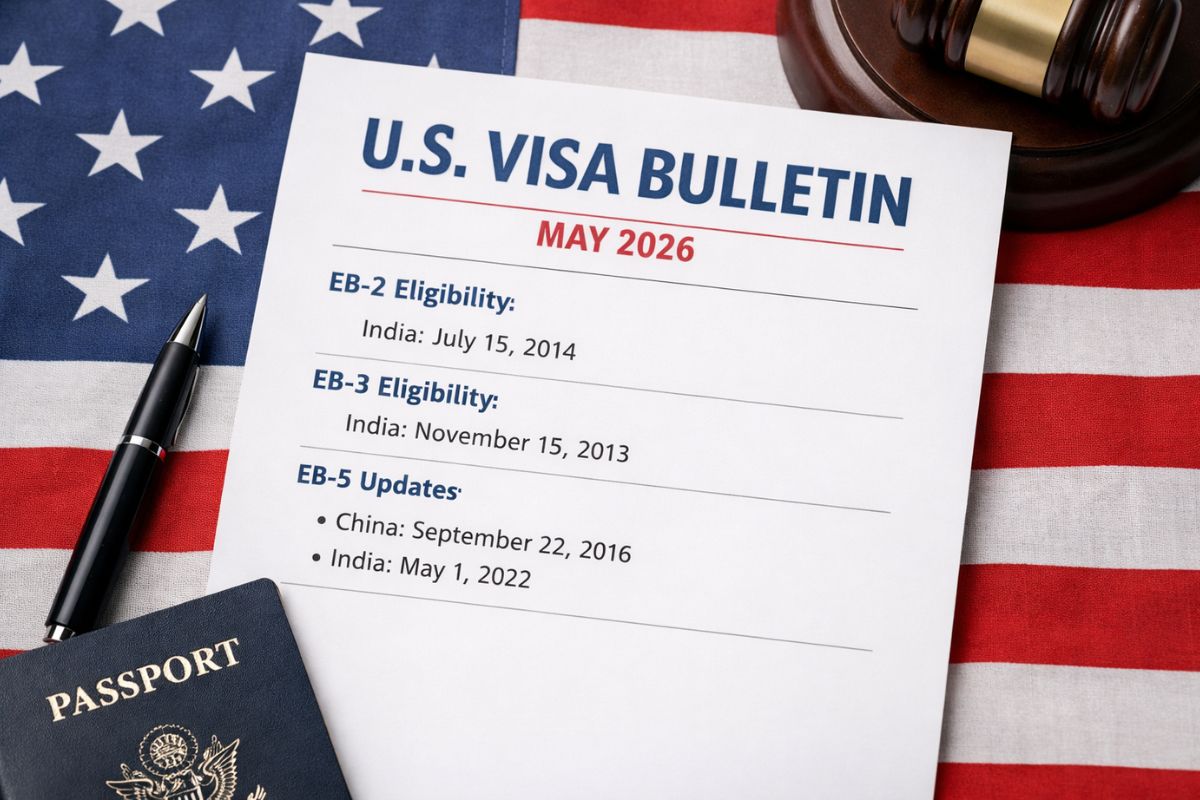
The US Visa Bulletin for May 2026 presents minimal advancements for applicants from India. The backlogs for EB-2 and EB-3 categories continue to be extensive, while the EB-5 categories remain current.
The most recent US Visa Bulletin for May 2026 indicates that there is little transformation for individuals seeking employment-based green cards, particularly those hailing from India. The majority of priority dates remain unmoved, which suggests that extensive waiting periods are set to persist.
The U.S. Department of State has indicated that USCIS will accept Adjustment of Status applications according to the Final Action Dates for May 2026. Therefore, applicants can advance only if their priority date precedes the specified cutoff.
Below is a straightforward summary of the shifts and their implications.
EB-1: No Advancement for India and China
The EB-1 Visa category, frequently utilized by top executives, researchers, and individuals with remarkable talents, remains stable.
- India: April 1, 2023
- China: April 1, 2023
- All other countries: Current
While individuals from most nations can proceed with their applications without interruption, applicants from India and China continue to endure delays.
EB-2: Extended Wait Times for Indian Applicants
The EB-2 visa, typically sought by individuals with higher educational qualifications, remains significantly backlogged for those from India.
- India: July 15, 2014
- China: September 1, 2021
- All other countries: Current
For those from India, this implies that attaining a green card may still require numerous years.
EB-3: Minimal Advancements for Skilled Workers
The EB-3 category pertains to skilled laborers and professionals. The priority dates exhibit minimal shifts.
Professionals and Skilled Workers
- India: November 15, 2013
- China: June 15, 2021
- Philippines: August 1, 2023
- All other countries: June 1, 2024
Other Workers
- India: November 15, 2013
- China: February 1, 2019
- Philippines: November 1, 2021
- All other countries: February 1, 2022
Indian applicants continue to confront one of the most protracted backlogs in this category.
EB-4: Cutoff Date Remains Unchanged
The EB-4 category, designated for specific immigrants such as religious workers, also remains steady.
- All countries: July 15, 2022
EB-5 Investor Visa: Minor Progress for China
The EB-5 immigrant investor visa shows minimal advancement for China, while India remains constant.
Unreserved EB-5 category
- China: September 22, 2016
- India: May 1, 2022
- All other countries: Current
EB-5 Set-Aside categories
- Rural projects: Current
- High unemployment areas: Current
- Infrastructure projects: Current
These set-aside categories remain current, providing quicker pathways for investors.
USCIS Indicates Adoption of Final Action Dates in May 2026
USCIS has confirmed the use of the Final Action Dates chart in May. Applicants can file for an Adjustment of Status only if their priority date is earlier than the designated cutoff.
Simply put, if your priority date is not current, you will need to wait longer to advance in the green card process.
Reasons for Slow Movement of Priority Dates
The State Department has observed that the recent shifts in visa availability are due to decreased levels of immigrant visa processing and policy decisions affecting various nations.
Authorities have also cautioned that if demand surges, dates may regress later in the fiscal year. This phenomenon is referred to as retrogression and often occurs when visa ceilings are nearly reached.
There is also a chance that the EB-5 category for India might encounter retrogression if the number of applications continues to rise.
Implications for Applicants
For the majority of applicants, particularly those from India, the Visa Bulletin for May 2026 indicates that advancement is slow. Key takeaways include:
- EB-2 and EB-3 backlogs for India remain excessively lengthy
- EB-1 shows no changes
- EB-5 set-aside categories maintain current status
- USCIS will adhere to Final Action Dates for filings in May
- Retrogression remains a potential issue later in FY 2026
Individuals planning to relocate to the United States for employment purposes should keep a close eye on the monthly Visa Bulletins, as even minor shifts can significantly affect application timelines.
Fonte: Travelo Biz
